

‘You can make life simpler for every family’: Georgia Senate passes bill to eliminate daylight savings time
- Brian Wellmeier
- Mar 25
- 2 min read
By: Brian Wellmeier
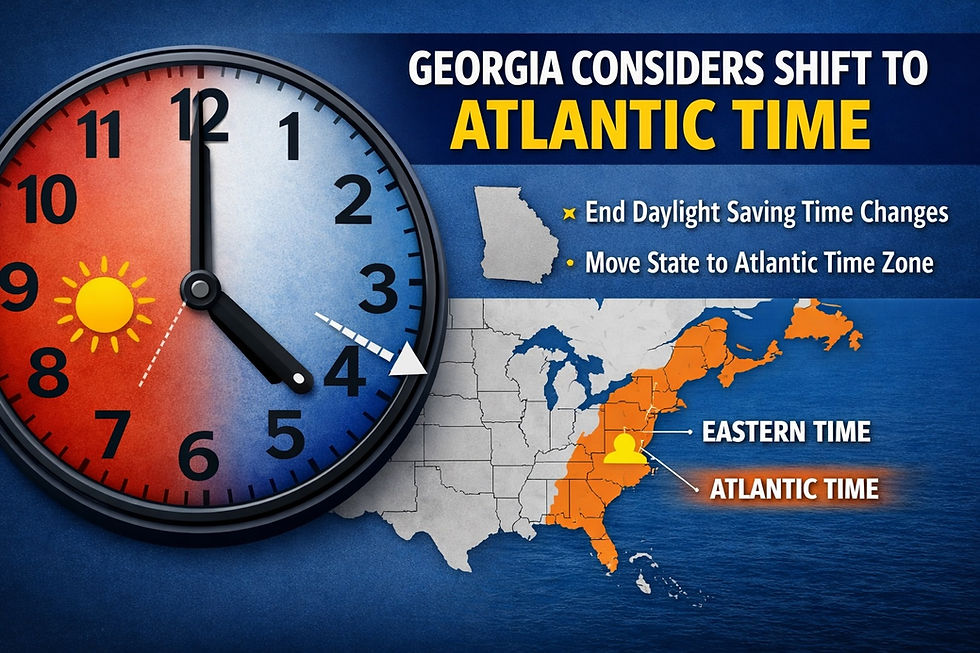
Georgia lawmakers have revisited efforts to eliminate the twice-yearly clock change, advancing legislation that could eventually move the state out of the Eastern Time Zone.
The proposal, known as the Georgia Sunshine Protection Act, passed the Georgia State Senate on Monday in a 45–5 vote. The measure calls for the state to pursue all legal avenues to adopt permanent daylight-saving time.
The bill’s sponsor, Georgia State Senator Bo Hatchett, R-Cornelia, told WCHM the change is long overdue.
"Congress has had years to fix daylight saving time and hasn’t,” Hatchett said. “The Sunshine Protection Act would finally give states the ability to keep a consistent schedule year-round, something most people already want. “
Because federal law does not currently allow states to unilaterally adopt permanent daylight-saving time, the legislation also outlines an alternative path. It directs the state to seek approval from Congress to move Georgia into the Atlantic Standard Time zone and opt out of observing daylight saving time altogether.
The Atlantic Time Zone is used in parts of Canada, including Nova Scotia, as well as in Puerto Rico and the U.S. Virgin Islands. Unlike the Eastern Time Zone, it does not require seasonal clock changes if daylight saving time is not observed.
The latest effort builds on legislation passed five years ago by the Georgia General Assembly and signed into law by Brian Kemp.
Under the current proposal, the state also would seek formal approval from the U.S. Secretary of Transportation to move Georgia into the Atlantic Time Zone and exempt it from advancing clocks by one hour during designated daylight-saving periods.
“This is one of those rare issues where you can make life simpler for every family in the state, and that’s exactly what we should be doing,” Hatchett said.
Most states currently observe daylight saving time, with the exceptions of Hawaii and Arizona.
The measure now continues through the legislative process as state leaders seek a long-term solution to the biannual time change.



Comments