
Gainesville Inland Port Opens, Ushering in a New Era for Northeast Georgia
- Nora Almazan
- May 5
- 2 min read
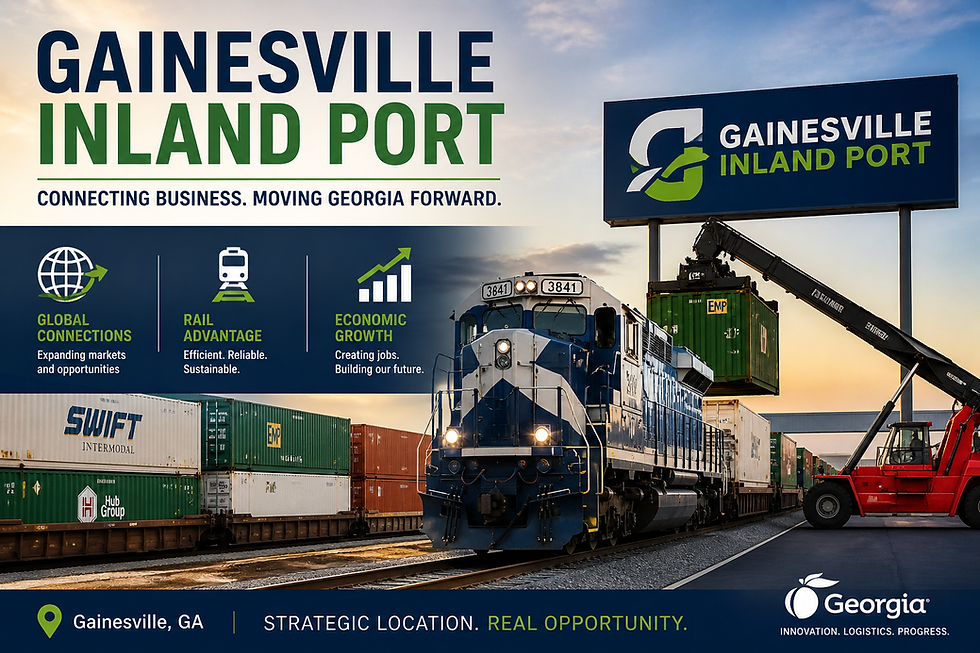
On a stretch of White Sulphur Road that once carried mostly local traffic, something much bigger is now taking shape.
After nearly nine years of planning, the Gainesville Inland Port is officially open— positioning Northeast Georgia as a more direct player in global trade.
Developed by the Georgia Ports Authority, the facility creates a powerful new link between Gainesville and the Port of Savannah—not by highway, but by rail. Containers that once relied on long, continuous truck routes can now move inland by train, arriving closer to the businesses that depend on them.
At first glance, it’s a rail yard—104 acres, three long working tracks, and a steady rhythm of freight movement. But what it represents goes much deeper.
This is about change
This is about changing how goods move across Georgia. Instead of trucks traveling hundreds of miles back and forth to the coast, the inland port allows cargo to be transferred to rail for the long haul. From Gainesville, those goods can then be distributed regionally with shorter, more efficient truck routes.
“Our new inland rail facility in Gainesville, Georgia, will significantly offset truck traffic congestion in Atlanta and improve air quality by replacing an estimated 26,000 truck roundtrips in the first year alone,” said Griff Lynch, President and CEO of the Georgia Ports Authority.
Behind the scenes, partnerships made the project possible. The rail infrastructure connects directly into the network operated by Norfolk Southern, which also invested in the project—further anchoring Gainesville into a much larger logistics system.
It is not a standalone
The Gainesville Inland Port joins a broader network that includes the Appalachian Regional Port, the Bainbridge Terminal, and the Carolina Connector. Each one is designed to move cargo more efficiently inland, reducing strain on highways while expanding access to global markets.
The timing is significant
The region has seen steady growth in manufacturing and industry—from food processing to automotive supply chains and life sciences. With that growth comes increased demand for reliable, scalable transportation. The inland port answers that need, offering a way to move goods faster while reducing logistical bottlenecks.
Brings long-term potential
At full capacity, the Gainesville facility is expected to handle up to 200,000 containers annually—positioning it as one of the more impactful inland ports in the state’s system. Leaders anticipate it could eventually surpass similar facilities in scale and throughput.
Closer to home, the project also reshaped the surrounding infrastructure. Investments in local roads improved traffic flow, removed a rail crossing, and ensured emergency access remains uninterrupted—small but meaningful changes for the community surrounding the site.
There’s a bigger picture
This inland port doesn’t just move freight—it shifts how a region connects to opportunity.
For businesses, it means greater access. For drivers, fewer long-haul trips. For the community, a sign that growth isn’t slowing down—it’s evolving.
For Gainesville, it marks the beginning of something that’s been years in the making… finally coming to life.


Comments